Airport Photos
Airport Photos is a short story set in a country that has confiscated every private camera. Resource scarcity and a totalitarian turn have left one state system, MemoreVisium, as the only lawful source of images — a generative model trained on years of government footage to guarantee “a consistent and truthful visual identity for our nation.” Everything from textbooks to bus-stop advertising now comes through this system. Individuals use MV terminals as places where you type a description and receive an A5 print.
I wrote it to work through a tension that surfaced in an interview study with documentary photographers. The photographers valued generative AI as a way for people to share their experiences while staying anonymous, and they distrusted it for exactly the qualities that make documentary work matter — depth, emotional authenticity, representational accuracy. What sits underneath both positions is a question about representational agency: not only what an AI system depicts, but whose perspective and whose feeling survive the depiction.
Storytelling suits that question better than prototyping does. Building and testing a model means arguing with its technical constraints; a story can go straight to what such a system would do to the people living with it. Several projects have shown that AI-generated images can carry real meaning for the people who make them, shaping how they hold memory and identity. I wanted to find where that meaning-making breaks — and where it might be made instead.
An excerpt
The narrator, a visitor leaving this country, finds one of the MV terminals at the airport. It resembled an arcade console stripped of color. The game controllers had been replaced with an industrial keyboard and mouse ball, and the outside had been lined with big stickers of the airport code and a marketing slogan, “Enhancing every Frame.” They describe the best thing they saw on their trip:
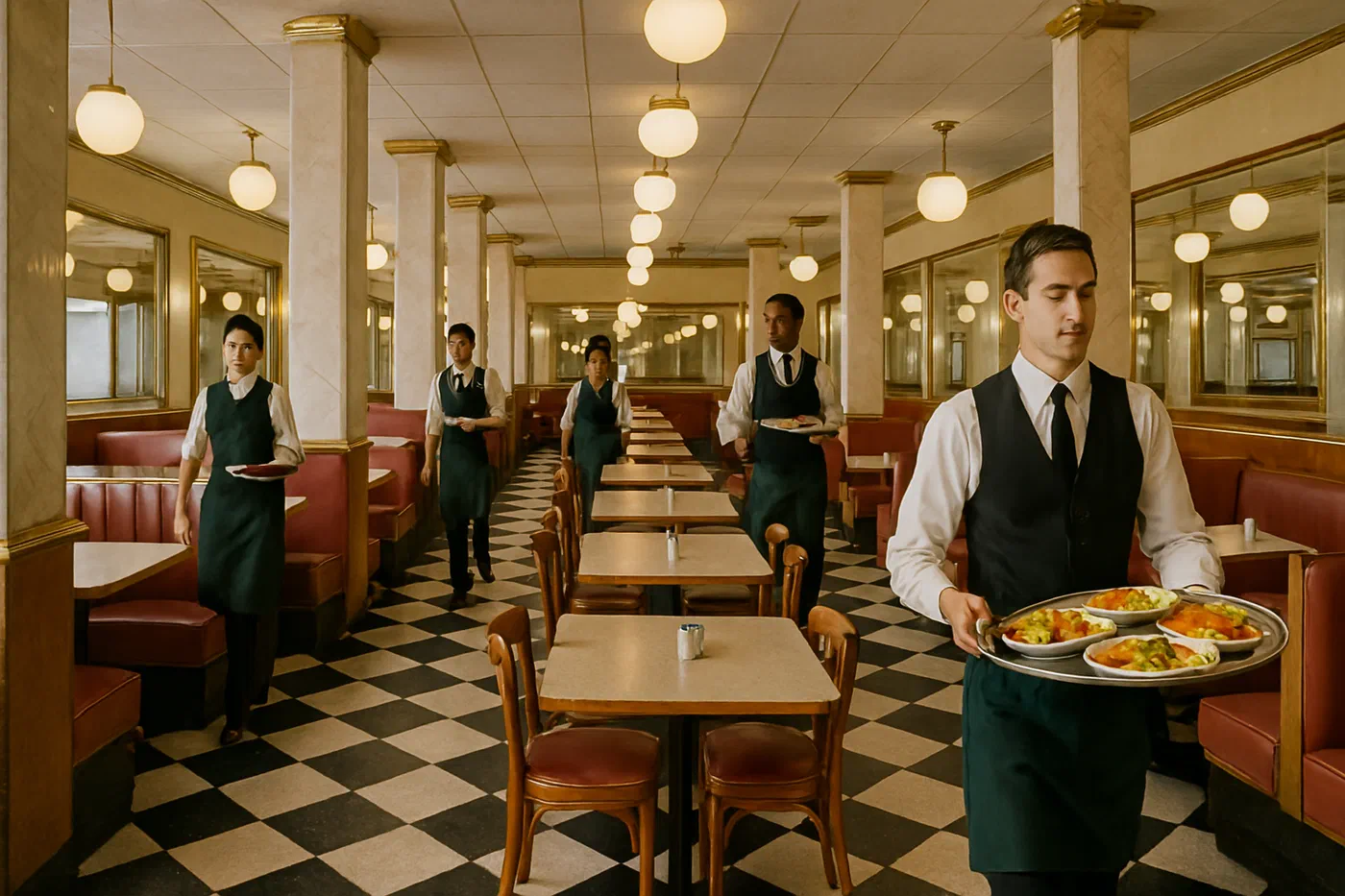
I visited this famous restaurant that had been open for 50 years and had become a central part of the community. The building was on the street corner with a small parking lot that I never saw empty. The building had never been remodeled and had the original decorations. It reminded me of what Las Vegas could look like when it was built: bright and flashy with a sense of grandeur. Compared to the other shops and houses in the area, it was like a pearl. Inside, it looked like a diner from the 1950s or 1960s America with checker-patterned floors and clean surfaces. There were marble columns throughout the interior and big mirrors on most walls. It felt like being at church. All the waiters, regardless of gender or race, wore black trousers with white button-downs and a black tie and vest. They all had the same dark green aprons. It felt like I’d been transported back in time. The food they brought out looked delicious on big silver trays. Each plate was colorful, and the portions were so generous…

The colors were duller than I remembered, and the food looked nothing like I’d described. Many of the things I mentioned were represented in the visual, but it lacked the tone of how I felt when I’d seen them.
They spend the rest of the wait tweaking the description, and check in for their flight with the failures stuffed into their bag.
The version I didn’t write
I began with a visitor’s frustration: someone trying to document a trip, getting images that capture elements of reality while reflecting the system creator’s sentiment rather than their own. From outside, being unable to make pictures of your own life reads as distressing: your past will always be blanketed by someone else’s perspective.
But partway through I started thinking about children who had never used a camera, and who would have no such loss to feel. In my head MemoreVisium works like a photo booth: kids showing up with props and stickers (in the form of words), taking turns, coming away with a long roll of pictures of themselves and their friends. Two best friends might describe themselves as “two cartoon foxes playing soccer in the exact park we always go to: one in a grey bucket hat, the other in a blue baseball cap”, and the machine returns something entirely unrealistic that is nevertheless true to how they feel.
That version isn’t written yet. It points somewhere the dystopian reading can’t reach, one of synthetic images as a medium for collective imagination.
The story was accepted to the HCI Design Stories workshop at CHI 2025 in Yokohama, Japan, where I shared it with the workshop group and took part in the day’s discussions. It remains a draft, and a starting point for new work.